
Why Traditional Weight Loss Advice Doesn't Always Work for Women (And What We're Learning About Hormones, Metabolism & Lasting Results)

If you've ever felt like you're doing everything right but still can't lose weight, you're not alone.
Many women spend years following the same advice they've heard over and over:
Eat less. Exercise more. Be consistent. Yet despite their efforts, the scale barely moves. Or worse, they lose weight temporarily only to gain it back again.
This often leads to frustration, guilt, and the feeling that they simply aren't trying hard enough, but what if the problem isn't a lack of effort? What if the traditional weight loss conversation has been missing important pieces of the puzzle?
Today, researchers and healthcare providers are learning more about the unique biological factors that influence weight management in women, including hormones, metabolism, sleep, stress, and the natural changes that occur throughout different stages of life.
Women Experience Weight Loss Differently Compared to Men
For decades, much of the exercise and nutrition research used to guide health recommendations was conducted primarily on men.
While those findings remain valuable, researchers now recognize that women experience unique physiological changes that can significantly influence body composition, metabolism, appetite, and energy levels.
Unlike men, women experience regular hormonal fluctuations throughout life, including:
Menstrual cycles
Pregnancy and postpartum changes
Perimenopause
Menopause
Each of these stages can influence how the body stores fat, responds to exercise, regulates hunger, and utilizes energy.
As a result, weight loss is often far more complex than simply reducing calories.
For Women, Weight Loss Often Gets Harder in Your 30s and 40s
Many women notice a shift in their body during their 30s and 40s. The habits that once helped maintain a healthy weight suddenly seem less effective.
Clothing fits differently and energy levels begin to change. Weight accumulates around the midsection. Research suggests that these changes are not simply about aging. Hormonal fluctuations during perimenopause and menopause can influence body composition, fat distribution, sleep quality, and metabolic health.
According to the Office on Women's Health, lower estrogen levels may contribute to weight gain while age-related changes in metabolism and muscle mass also play a significant role.
Harvard Health notes that many women experience a shift toward increased abdominal fat storage during menopause as estrogen levels decline. Loss of muscle mass can further reduce the number of calories the body burns at rest.
This means that many women are not imagining these changes. Their bodies are changing, and their approach often needs to change as well.
The Symptoms Women Often Notice First
Weight gain is rarely the only symptom. Many women begin noticing several changes happening at the same time.
Common concerns include:
Weight gain around the stomach
Fatigue despite adequate sleep
Increased cravings
Brain fog
Poor recovery from exercise
Difficulty building or maintaining muscle
Sleep disturbances
Mood changes
These symptoms may develop gradually, making them easy to dismiss at first.
Over time, however, they can significantly impact overall health and quality of life.
Why Dieting Harder Often Makes Losing Weight Worse
When weight loss stalls, the natural response is often to become more restrictive.
Many women begin cutting calories further, increasing cardio, or eliminating entire food groups.
While this may create short-term results, it can sometimes create additional challenges.
Highly restrictive dieting may:
Increase hunger signals
Reduce energy levels
Make exercise recovery more difficult
Contribute to muscle loss
Become difficult to sustain long-term
This helps explain why many women find themselves trapped in a cycle of losing and regaining the same weight repeatedly. The issue is often not a lack of discipline. The issue is that the body is more complex than a simple calorie equation.
What Research Is Teaching Us About Metabolism
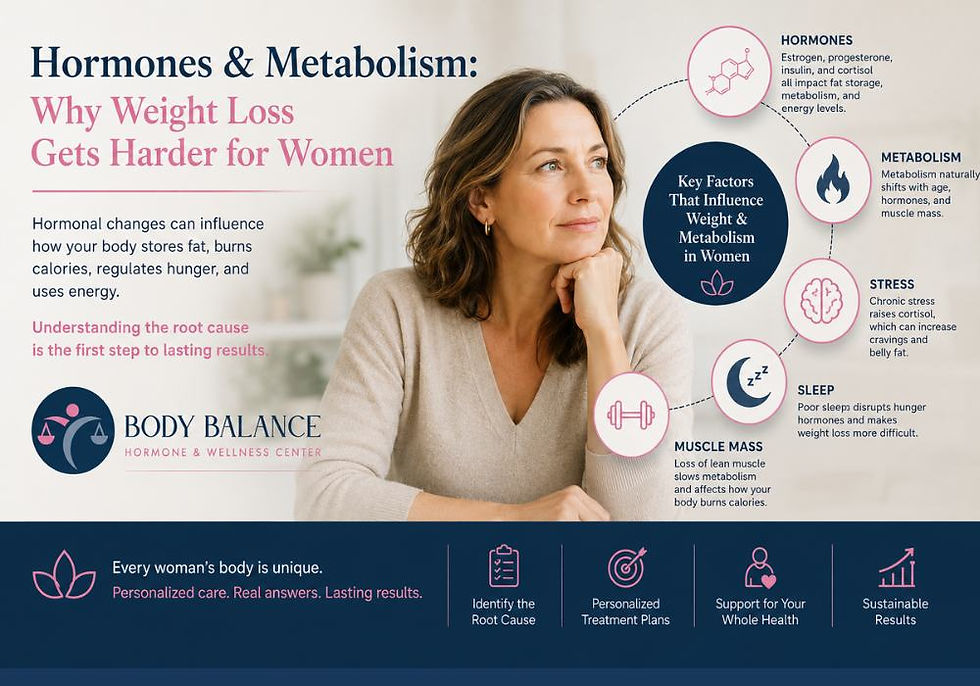
One of the most interesting developments in recent years is our growing understanding of metabolism.
Many people assume metabolism dramatically slows after age 30.
However, research highlighted by Harvard Health suggests that metabolic changes may be more nuanced than previously believed. Instead, factors such as muscle loss, physical activity levels, hormonal shifts, sleep quality, and body composition appear to play a larger role in midlife weight gain than metabolism alone.
This is encouraging because many of these factors can be influenced through targeted interventions and lifestyle changes.
The Missing Conversation: Hormones, Stress & Sleep
When discussing weight loss, three important topics are often overlooked:
Hormones
Hormones influence hunger, energy production, fat storage, muscle maintenance, and metabolism. Changes in estrogen, progesterone, insulin, cortisol, and testosterone can all affect how the body responds to diet and exercise.
Stress
Chronic stress can contribute to elevated cortisol levels, disrupted sleep, increased cravings, and changes in fat distribution.
Sleep
Poor sleep affects appetite regulation, recovery, energy levels, and decision-making. Many women entering perimenopause experience sleep disruption long before they recognize hormonal changes are occurring.
These factors often work together, creating a cycle that makes weight management significantly more challenging.
What Many Women Are Missing if They're Trying to Lose Weight
The answer is not necessarily eating less. The answer is not necessarily exercising more. For many women, the missing piece is understanding what is happening inside their body.
That may involve evaluating:
Hormonal health
Sleep quality
Stress levels
Metabolic factors
Nutrition habits
Lifestyle patterns
When these pieces are addressed together, weight management often becomes more sustainable and less frustrating.
How Body Balance Approaches Weight Loss
At Body Balance, we recognize that successful weight management requires a personalized approach.
Rather than focusing solely on calories or the number on the scale, we look at the bigger picture.
Depending on the individual, this may include evaluating hormone health, metabolic factors, lifestyle habits, sleep quality, and overall wellness goals.
Our goal is to help patients better understand what may be contributing to their challenges and develop a strategy that supports long-term health, not just short-term weight loss.
Why Women in Fayetteville Choose Body Balance
Patients choose Body Balance because care is personalized, evidence-based, and focused on the individual.
As a locally owned, APRN-led practice, we understand that no two women experience weight gain, hormone changes, or wellness challenges in exactly the same way.
Every treatment plan begins with understanding the whole person—not simply the number on the scale.
Frequently Asked Questions About Female Weight Loss & Hormone Health
Can hormones really make it harder to lose weight?
Hormones influence metabolism, hunger, energy levels, fat storage, and muscle maintenance. Changes in hormone levels can make weight management more challenging for some individuals.
Why do women gain weight around their stomach during menopause?
Is weight gain during perimenopause normal?
Many women experience weight and body composition changes during perimenopause, though the degree varies from person to person.
Does metabolism slow down with age?
Changes in muscle mass, activity levels, and hormonal health appear to play a significant role in midlife weight changes. Metabolism alone may not explain all weight gain.
When should I seek professional guidance?
If you've been struggling with weight gain, fatigue, low energy, poor sleep, or other symptoms despite consistent efforts, it may be worthwhile to discuss your concerns with a qualified healthcare provider.
Patient Guidance Notice
This content is for informational and educational purposes only and is not intended as medical advice, diagnosis, or treatment. Individual results may vary. The information provided should not replace a consultation with a qualified healthcare provider.
Body Balance is a medical practice operated by a licensed APRN. Any treatment decisions are made on a case-by-case basis following a comprehensive evaluation. Statements regarding treatment outcomes are based on clinical experience and are not guarantees of specific results.
If you are experiencing symptoms or have concerns about your health, please schedule a consultation for a personalized evaluation.

Comments